
from my 2024 post in ModPo
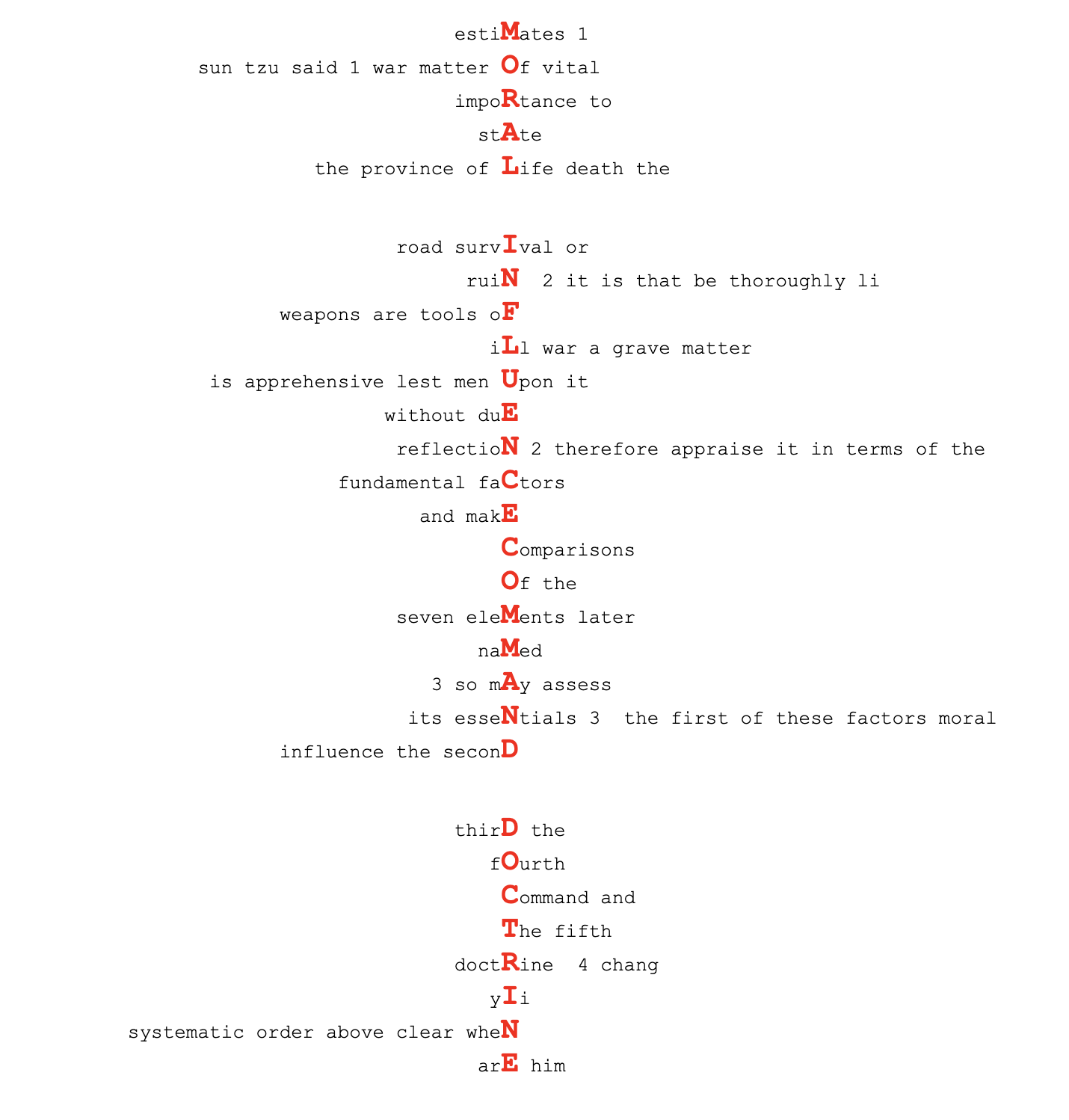
This Cagean mesostic poem, is built around the spine words “MORAL INFLUENCE, COMMAND, DOCTRINE,” that draws from Sun Tzu’s Art of War to explore a critical subset of the five fundamental factors he identifies for appraising war. The other two are TERRAIN and WEATHER. Too long for the spine.
SunTzu considers moral influence to be a key determinant of success in war. He states: war is the province of life or death, the path to survival or ruin. Therefore, chances are also of life and death. Because all warfare is based on deception, there is always the chance that one side will be tricked and deceived— resulting in unintended consequences. Although estimates and appraisals before wars are possible in terms of Sun Tzu’s 5 crucial factors, pondering results are still random guesses.
By Dao, Sun Tzu means “moral influence” or the right way, which refers to the morality of government. And by moral influence, Sun Tzu means that which causes the people to be in harmony with their leaders so that they will accompany them in life and unto death without fear. By weather and terrain we understand these to be obvious, but by “command” – very important – Sun Tzu means the general’s qualities of wisdom, sincerity, humanity, courage and strictness. By doctrine, he means “organization, control, assignment of appropriate ranks to officers, regulation of supply routes, and the provision of principal items used by the army.”
This mesostic poem uses the fragmented language of The Art of War to construct a powerful argument for the primacy of moral influence in warfare. It underscores that true victory is not solely achieved through tactical prowess but is deeply rooted in the ethical foundations of the governing power. By focusing on “moral influence, command, and doctrine,” the poem reveals a core principle of Sun Tzu’s philosophy: a just and moral government possesses a strategic advantage that transcends mere military might.
The fractured phrases, revealed through the spine, create a disjointed yet compelling narrative, highlighting the significance of a government’s morality, even in the midst of the chaos and brutality of war.
SunTzu begins by establishing the gravity of war: “estimates of vital importance to state.” This underscores the profound impact of conflict on the very survival of a nation. The phrase “the province of life and death” further emphasizes the ultimate stakes. War, in its essence, is a matter of life and death, a reality that directly influences the moral choices of those in power.
The poem introduces the destructive potential of war with the word “ruin.” The phrase “ruin 2 it is that be thoroughly” suggests the pervasive nature of war’s devastation, impacting not just physical structures but also the moral fabric of society. The line “weapons are tools of ill war” reinforces the negative connotations of conflict, positioning weapons as instruments of harm.
The emergence of the first spine word, “MORAL,” amidst this backdrop of destruction highlights its crucial role. This placement emphasizes that ethical considerations cannot be ignored, even in the face of overwhelming violence. The subsequent lines, “is apprehensive lest men upon it without due reflection 2 therefore appraise it in terms of the fundamental factors,” urge careful deliberation and a comprehensive analysis before resorting to war.
The phrase “fundamental factors” points to Sun Tzu’s framework for evaluating war, of which the poem’s spine represents a crucial subset. The lines “3 so may assess its essentials 3” emphasize the need for thorough evaluation, with the repetition of “3” even though by chance, we can consider it to allude to the multifaceted nature of war and its moral implications. The declaration, “the first of these factors moral,” explicitly elevates the morality of governance to the primary position among these essential considerations. This prioritization of moral influence suggests that a government’s ethical standing is paramount in determining the outcome of war.
The following spine words, “INFLUENCE, COMMAND, DOCTRINE,” delve into the practical application of this moral foundation. “INFLUENCE” signifies the government’s ability to inspire and motivate its people, a power derived from its moral authority. “COMMAND,” following “influence,” highlights the importance of ethical leadership in directing military forces. “DOCTRINE,” the final spine word, represents the guiding principles and strategies that shape military action, ideally informed by the government’s moral compass. These words, taken together, demonstrate the cascading effect of moral influence, starting from the government and permeating through the military hierarchy down to the execution of warfare itself.
The poem’s lower section further reinforces the connection between morality and military effectiveness. Words like “command” and “doctrine” connect directly to the spine words, emphasizing their role in a well-functioning military. The final phrase, “clear when a E him,” though ambiguous, can be interpreted as the clarity of purpose and action that arises when a leader embodies and upholds strong moral principles.

